
Sex Offender Checks in Ogle County
The primary public channel is the Illinois State Police Sex Offender Registry, which ISP says is updated daily. It covers people who must register under the listed Illinois laws after a qualifying conviction, insanity finding, or adjudication. For Ogle County results, search by county or narrow a name search with a date of birth, city, or ZIP code. Broad searches are useful when spelling or a precise address is uncertain.
Registration occurs at a city police department for a person living within city limits and at the Ogle County Sheriff for someone in an unincorporated area. The sheriff links a local registration channel and can receive reports of suspected noncompliance at its Public Safety Complex. The state registry remains the public search source; the local agency handles registration and verification. A person seeking the conviction paperwork should follow the registry profile to the Circuit Clerk in the county of conviction.
The ISP Conditions Come First
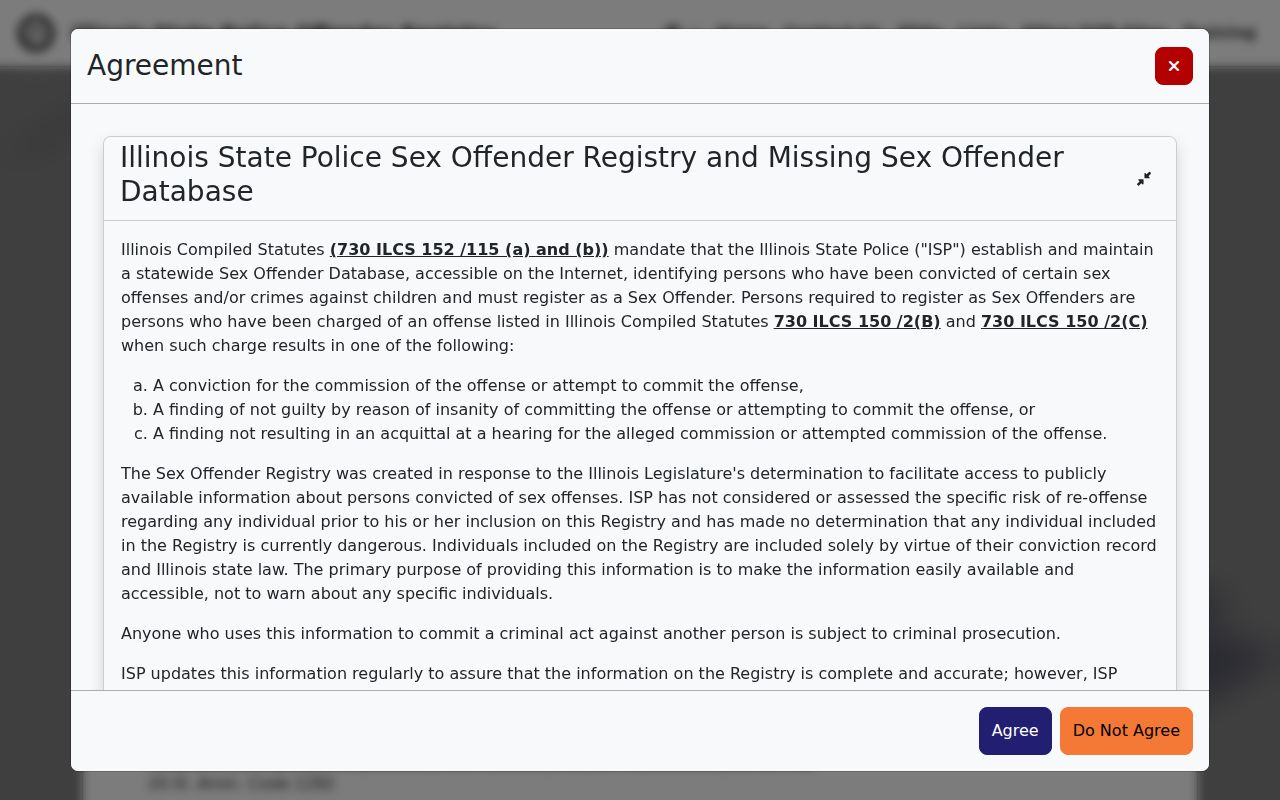
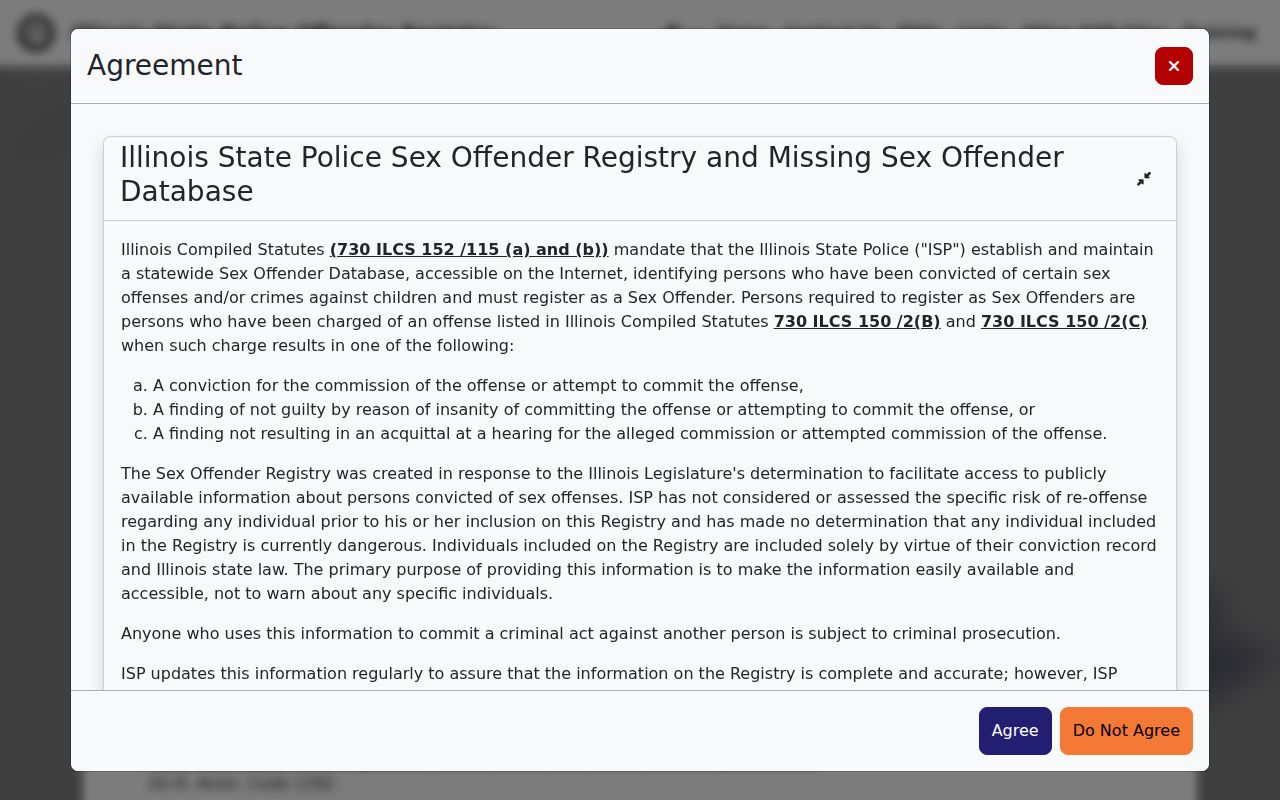
The registry opens with conditions that explain its scope and prohibit misuse. The ISP registry warning is worth reading before accepting because it makes clear that the database is not a full criminal history, may contain errors, and does not predict whether anyone will reoffend.
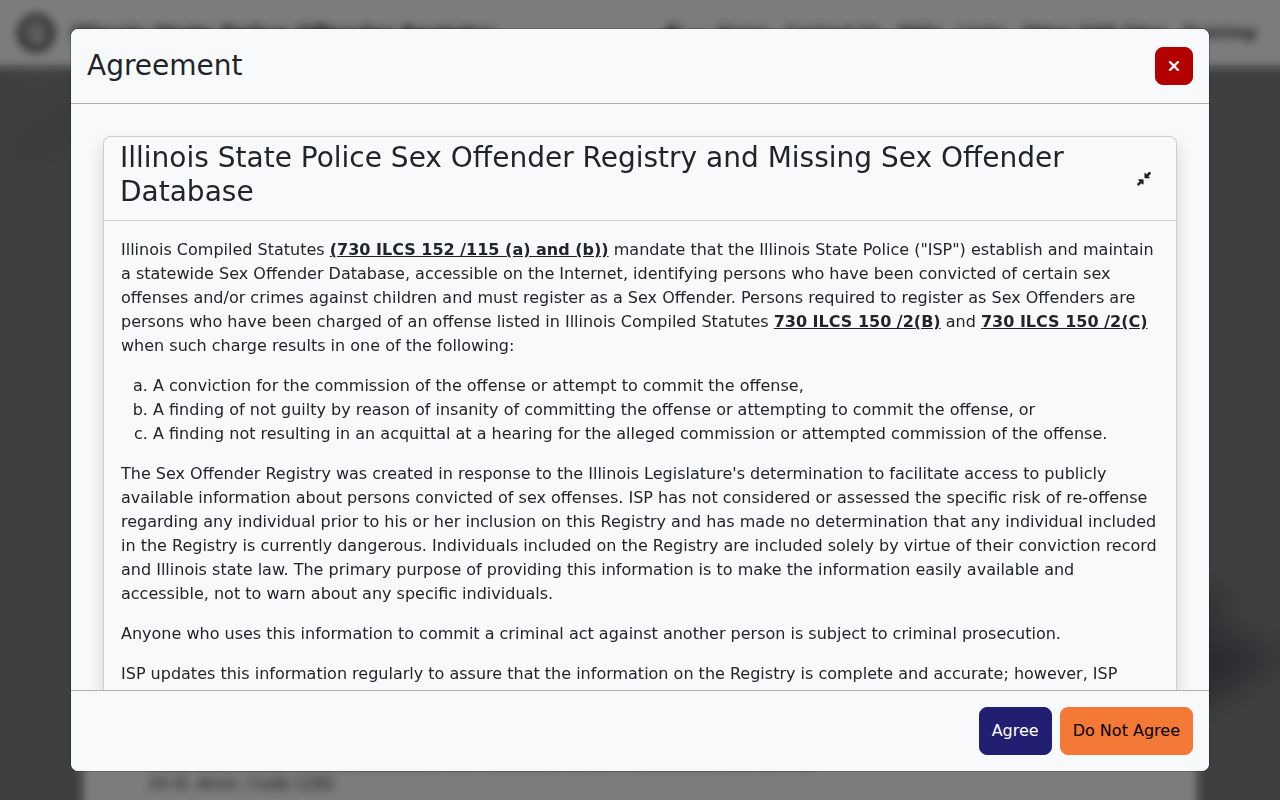
That opening notice should shape the entire search: use the information for awareness and safety planning, verify uncertain details with the registering agency, and never confront a person based on a search result.
How to Search the Illinois State Police Sex Offender Registry
The registry offers both identity and geography fields. No single field is marked as universally required in the documented interface, so a broad county or city search can reveal nearby records while a combined first name, last name, and birth date can distinguish people with similar names.
- Open the ISP registry, read its conditions of use, and accept them to reach the search form.
- Enter a name or select Ogle from the county dropdown; add city, ZIP code, birth date, status, or offender type only when useful.
- Compare the result list with known identifiers rather than relying on a name alone.
- Open the matching profile and review status, registering agency, dates, address presentation, photographs, and offense information.
The ISP registry search interface shows the actual filters available after the disclaimer.
The form supports a focused Ogle County search without requiring a searcher to center the inquiry on a private individual.
| Field Label | Type | Required | Notes |
|---|---|---|---|
| First and Last Name | Text | No | ISP suggests beginning with a name when known. |
| Date of Birth | Date/text | No | Use an exact date to narrow similar names. |
| City or ZIP Code | Text | No | Filters an Illinois place or five-digit ZIP. |
| County | Dropdown | No | Select Ogle; the list also has custody and out-of-state categories. |
| Status, Homeless, Offender Type | Dropdown/checkbox | No | Use only when the category is understood. |
Map an Ogle Neighborhood
“Map Your Neighborhood” is the registry’s separate geographic route. Enter an address or click a map location, begin with a broad view, and narrow it as needed. Yellow markers open details in a pane. The map can answer an address-centered safety question that a name search cannot, but it still reflects registered information rather than a guarantee about every person present in an area.
When the map and a profile appear inconsistent, capture the record details and contact the agency shown as the registering agency. Within Rochelle, Byron, or Oregon, that normally means the relevant municipal police department; outside city limits, contact the Ogle County Sheriff registration channel. ISP directs users who cannot locate a registrant to local law enforcement.
Inside a Registry Profile
A public profile combines identifiers, registration facts, and conviction information. Match several fields before treating a result as the correct person. ISP can display current and older photographs with their dates, aliases and alias birth dates, a registered address or other status presentation, and the agency responsible for registration. It may also list ages at the offense when the public source contains them.
| Name & Aliases | Displayed name, aliases, date of birth, and any listed alias birth dates. |
|---|---|
| Photo & Physical Description | Dated current or historical photographs plus height, weight, sex, and race. |
| Registered Address | The registered location or an out-of-state or other status presentation. |
| Offense & Statute | Crime description, statutory category, and county of conviction. |
| Level / Tier | Illinois statutory category and duration, not a simple public Tier I, II, or III label. |
| Registration Status | Compliance status, registering agency, registration dates, and duration. |
Vehicle, workplace or school, eye and hair color, and scars or tattoos were not consistently confirmed in the inspected profiles, so a searcher should not assume those fields will appear. The Print This Record control preserves what was visible at that moment; it does not turn the profile into a certified court record.
A Registry Is Not Criminal History
The registry answers a narrow statutory question: whether a person is publicly listed under Illinois registration law and what public registration details apply. It does not assemble every Ogle County arrest, charge, dismissal, or disposition. For the prosecution record, follow the profile’s county-of-conviction information to that county’s Circuit Clerk. Ogle convictions can be researched through Ogle County criminal court cases and the clerk-linked Judici search.
This distinction also matters when no result appears. A no-match search does not establish that a person has no criminal history. The conviction may not carry a registration duty, a ten-year term may have ended, the person may appear under another spelling or location, or a different state may hold the relevant entry.
Illinois Registration Levels and Requirements
Illinois does not present every registrant through a simple three-tier scheme. Public records instead use statutory categories, verification schedules, and registration duration. ISP explains that an ordinary ten-year registrant is removed from the website after completing the period if no extension applies. Lifetime duties and 90-day reporting apply to specified categories and events.
The ISP registration FAQ explains duration, frequency, address duties, photographs, and fees.
Those category-specific rules are why the profile’s exact label matters more than forcing an Illinois entry into another state’s tier vocabulary.
| Illinois Category or Event | Duration | Verification Frequency |
|---|---|---|
| Ten-year registrant | Statutory period, subject to extension | As required by the Act |
| Sexual predator | Natural life | Annually |
| Sexually dangerous or violent adjudication | Natural life | Every 90 days |
| Registration Act conviction after July 1, 2005 | Applicable registration duration | Every 90 days |
| First-degree-murder registrant under SORA | Natural life | Annually |
Why Registration Time Can Change
A displayed end point is not always a simple count from the original registration date. ISP notes that incarceration can toll time, while violations, later sex offenses, administrative extensions, and other felony rules can extend or alter a duty. The current profile and the responsible registering agency are therefore better sources than an independent calendar calculation.
ISP states an initial $100 registration fee and a $100 annual fee, subject to the Act. Those are registration obligations, not fees to search the free public registry. A person with questions about their own duty should contact the registering agency and obtain legal advice rather than relying on a public profile summary.
NSOPW Beyond Illinois
The Illinois registry is the strongest starting point for Ogle County because ISP maintains the state record and local agencies report into it. When a search crosses state lines, the U.S. Department of Justice National Sex Offender Public Website provides a broader search across participating jurisdictions.
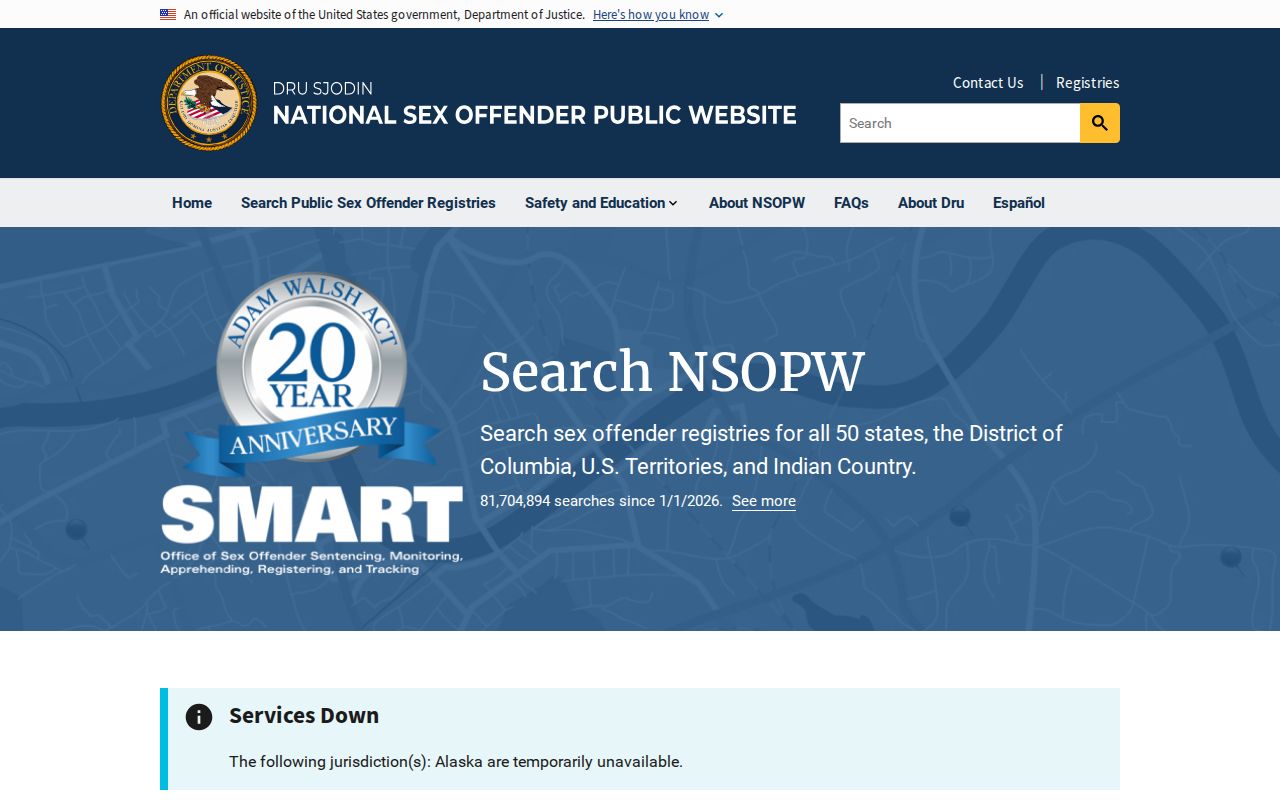
NSOPW adds geographic reach, while the Illinois profile and the named local registering agency remain the better sources for interpreting an Ogle County entry or reporting a possible error.
Community Notification and Lawful Use
Registry information supports personal, family, and neighborhood awareness. Searchers can review an address area, discuss age-appropriate safety plans, and report suspected noncompliance to law enforcement. They should not infer present conduct from a listing or treat the database as a substitute for a court file. Illinois restrictions involving residences, schools, or parks are statute-specific and fact-dependent; there is no sound basis for assuming one universal boundary applies to every listed person.
No harassment or threats: Illinois registry conditions prohibit using the information to harass, threaten, or intimidate a registrant or the registrant’s family. Report a safety or compliance concern to the registering police department or Ogle County Sheriff instead of confronting anyone.